ValueCompassAvailable now
Who is behind it, and does that fit your values?
Compare AI options on ownership, control and documented commitments, against the priorities you choose.
Try ValueCompass ↗Independent testing · Comparison · Informed choice
Hopperlace helps you choose AI tools and systems that fit your tasks, preferences and values, with evidence you can understand and inspect.
ValueCompass, which you can use today, adds research on the companies behind those tools: their ownership, dependencies and policies. We’re also developing independent, hands-on comparisons of the tools themselves.
Two parts of one decision
Compare AI options on ownership, control and documented commitments, against the priorities you choose.
Try ValueCompass ↗Find out which tools suit a particular task, and what effort, expertise and compromises each one involves.
Explore our testing approach ↓The aim is to bring these comparisons together with ValueCompass, so you can consider practical fit and values in the same decision.
01 / ValueCompassAvailable now
Opens valuecompass.ai. No account needed.
Who benefits from the money you spend on AI? What commitments do providers make to the people affected by their technology?
ValueCompass helps you examine the companies behind AI products and compare options against your values. Explore ownership, control, dependencies and documented policies, with sources and clear gaps in the research.
Try ValueCompass ↗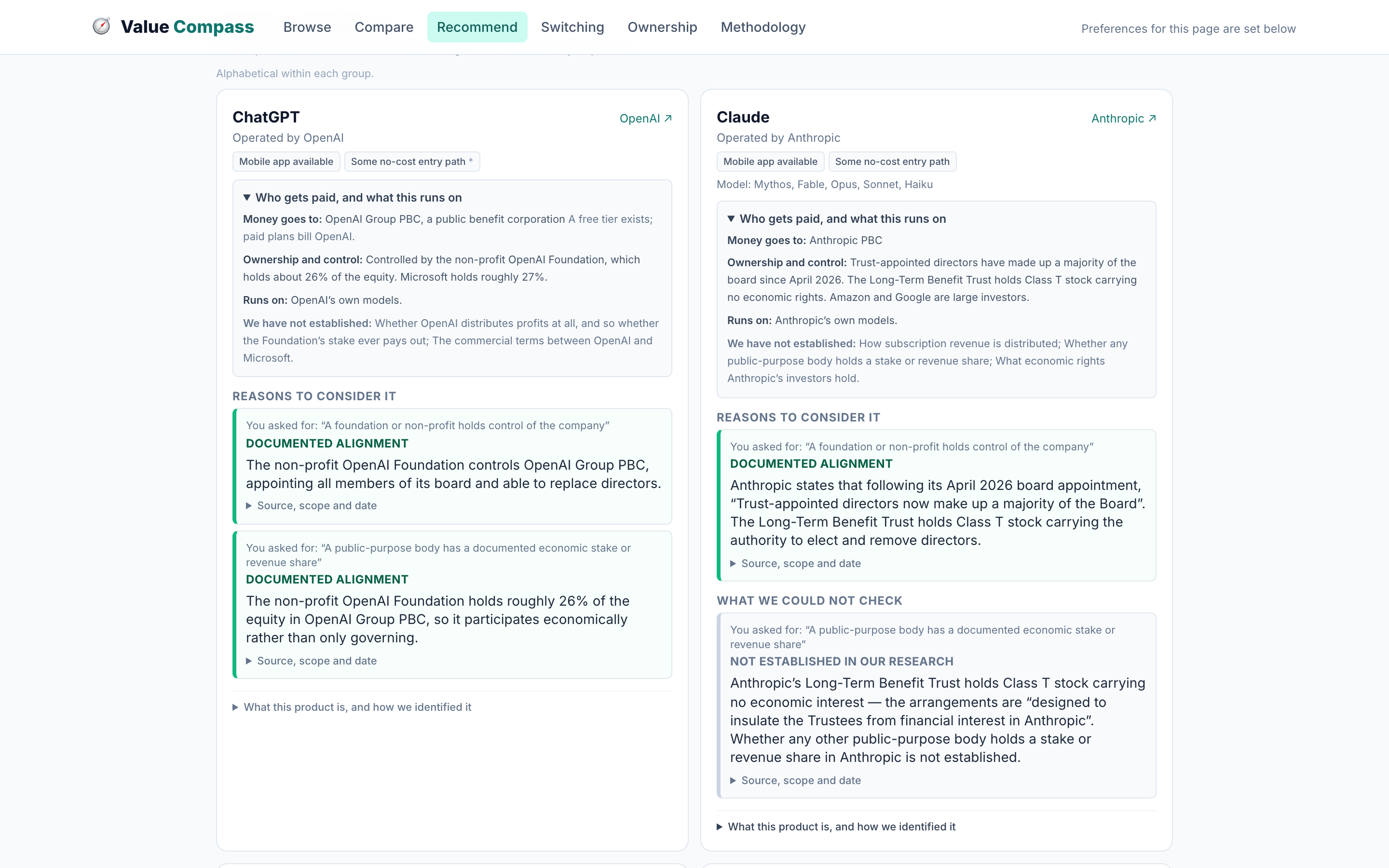 View example ↗
An example comparing nonprofit control and financial interests. Confirmed findings and unanswered questions appear separately.
Full captures: choosing priorities · summary of what was found · evidence on the cards.
02 / Tool testingIn development
Our comparisons will examine how well an option works for your task, what it asks of you, and the trade-offs involved in choosing it.
Does it accomplish your task to the quality you need? How consistently does it work across different cases and repeated attempts, and where does it fail?
How much setup, guidance, checking and correction does it require? What can you manage yourself, and where is specialist help needed?
Can you understand and check what it has done, approve consequential actions, intervene when needed, and recover from mistakes?
Can you adapt it as your needs change, diagnose problems and make improvements without breaking what already works?
What are you committing to? Can you move your data, work or setup elsewhere, and what would switching actually involve?
What does a useful result cost—including subscriptions, usage, retries and the human time involved?
Alongside these practical questions, ValueCompass helps you examine the ownership, relationships and documented practices behind your choices.ValueCompass · available now ↑
The specific tests depend on the task and the category of tool. The six dimensions are common questions, not an identical checklist or a universal score applied to every product.
First planned category
Our first comparisons will apply the framework to tools that build apps from natural-language instructions. The example below shows how each dimension becomes a concrete check.
Decision
Which AI app builder suits a small-business owner with limited technical experience?
Intended outcome
A comparison of which tools suit this user, where specialist help is needed, and the trade-offs involved.
Proposed checksNot findings · no results yet
03 / Founder

Hopperlace was founded by Yuyu Shen, a statistically trained data scientist turned product manager with nearly a decade building and evaluating AI systems, including taking AI products from zero to one.
She also built Evidence Synthesis AI, which helps research teams use AI to screen studies for systematic reviews. Her research on deference-aware evaluation was accepted at the ICML 2026 Technical AI Governance workshop. She holds CCA-F and CCA-P certifications and writes about technology, agency and better decisions at buildwithwhy.com.
Full background and credentials →Services
Hopperlace works with teams to compare options, test promising approaches and recommend what to use, build or investigate next.
Services →